Introduction
So, you want to run for office in Chicago. You’ll need money, you’ll need volunteers, you’ll need a half decent lawyer. But first and foremost, you will need the signatures of a few hundred of your friends, neighbors, and potential future constituents.
Petitioning is a Chicago staple, and if you’ve been near a CTA stop, farmers market, or busy intersection in the last year, odds are you’ve been (politely?) asked to stop and sign for some political aspirant. Get enough signatures, make it past signature challenges, and boom, you’re on the ballot.
In the spirit of political transparency, anyone can request petitions that have been submitted — but few do, outside potential challengers. In this article, I will show the utility of petition signature analysis as an early indicator of how political races are shaping up using the example of my home school board district, District 2b.
Background on the Elected School Board
After the passage of SB15 in 2021, Chicago’s school board began the process of change from appointment to election, with a first transitional election on the November 2024 ballot. During the following period of transition (2024-2026), the board would be half elected and half appointed, with 10 members and a Board President selected by the Mayor and 10 elected from newly-drawn districts across the city. This fall, the Board will be fully elected: each of the 10 districts will be split in half (denoted officially by the larger district’s number and ‘a’ or ‘b’), and a Board President will be elected citywide.
The half-and-half Board’s set-up has led to some confusion among even the most politically engaged. As this article will be about District 2, I will use it as an example. In 2024, an election for school board was held across all of District 2, and Ebony DeBerry won handedly. As she lives in the 2a portion of the District, she took the District 2a seat, and the Mayor was allowed to appoint a member for District 2b (Debby Pope). This structure is the same across the city — the elected winner of the larger District took the seat representing that Districts’ half in which they live, while the other half saw a mayoral appointment. Many of these appointed incumbents (Member Pope included) are now running for election in their own right.
Background on District 2b
District 2b contains the neighborhoods of Albany Park, Ravenswood, Lincoln Square, Bowmanville, and Andersonville, with large portions of Uptown and Edgewater and smaller pieces of Rogers Park, West Ridge, and North Center. It is one of just five majority-white districts, though is home to sizable Black, Latino, and Asian communities.
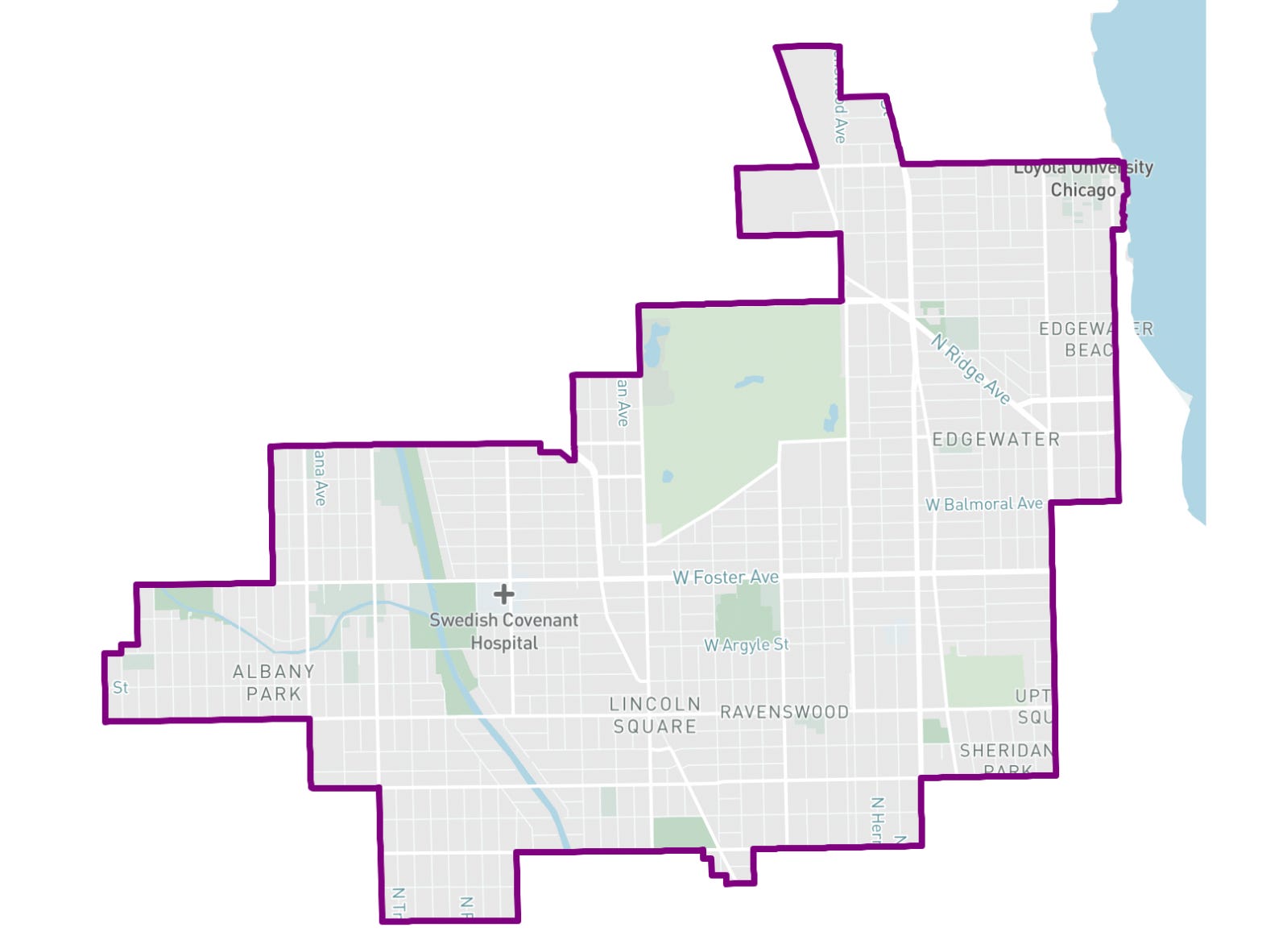
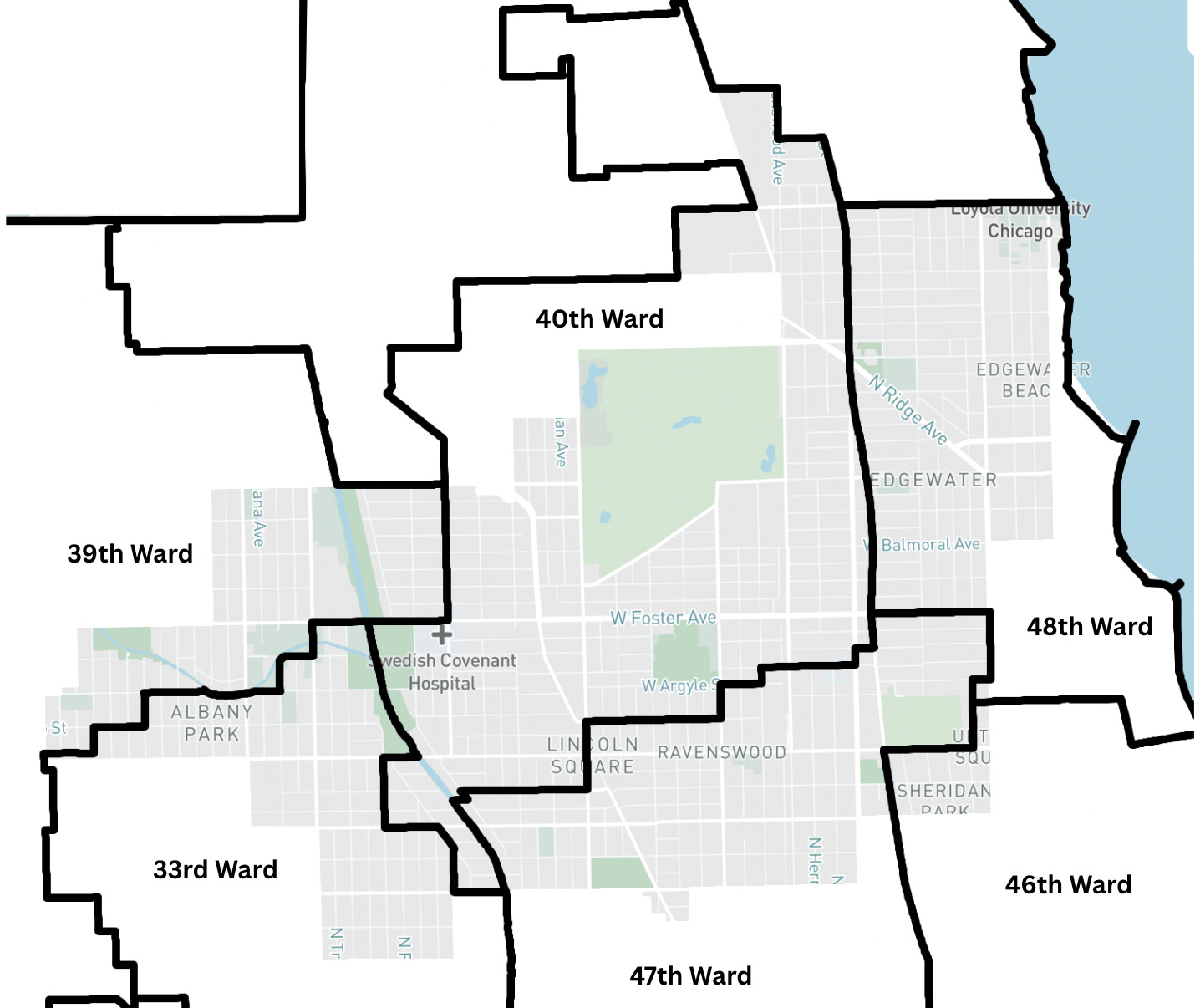
District 2b intersects with six wards, but is most concentrated in four: the 33rd, 40th, 47th, and 48th.
District 2b has been loyally progressive across other races, per my prior analyses. Mayor Brandon Johnson won 40% there in the first round (compared to 21.6% citywide) and 66% in the 2023 mayoral run-off against Paul Vallas. It gave the strongest support of any district in the city to the Bring Chicago Home referendum in 2024 (66.5%), and the city’s highest margin for incumbent County Assessor Fritz Kaegi in the March 2026 primary (68.9%).
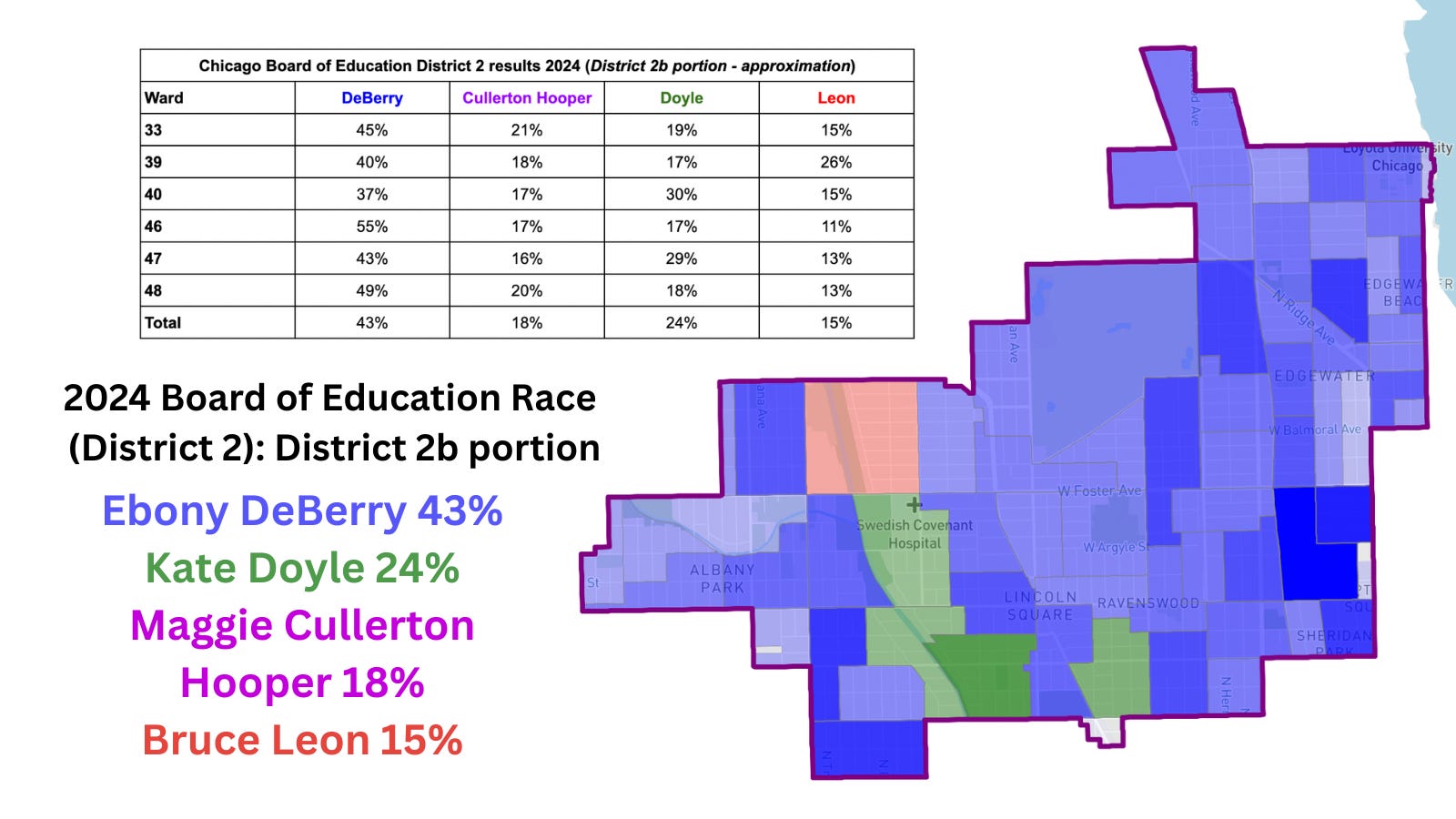
Let’s look for a moment at the 2024 District 2 race. After the Harris-Trump bout at the top of the ballot, far, far downballot was the race for School Board — here’s how votes split down across ward lines:
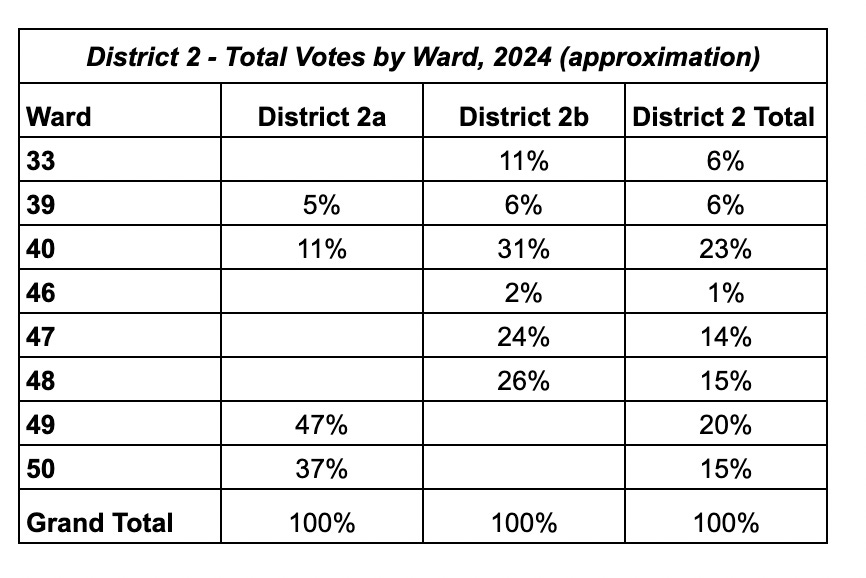
On her way to a district-wide rout, CTU-backed Ebony DeBerry won the 2b portion of District 2 by a little under 20%, primarily losing votes to Kate Doyle, who was backed by the 40th Ward Democratic organization and Maggie Cullerton Hooper, backed by two local Members of Congress.
Methodology
To gauge the state of the race (more later), I requested each of the three filed candidates’ petitions and hand-transcribed the addresses of each individual signer (mainly while watching World Cup games). I was then able to geocode these addresses via QGIS, and connect them with existing shapefiles. These data may not be exact — some addresses I was unable to parse, others may have been dropped in the geocoding process, but these addresses account for at most a few dozen of the 3,700+ analyzed.
District 2b: the state of the race
As it stands, three candidates have filed for the District 2b race: appointed incumbent Deborah ‘Debby’ Pope, former CPS educator and local Dem official Kyna Lenhof, and policy & data analyst Daniel Basco, Ph.D.
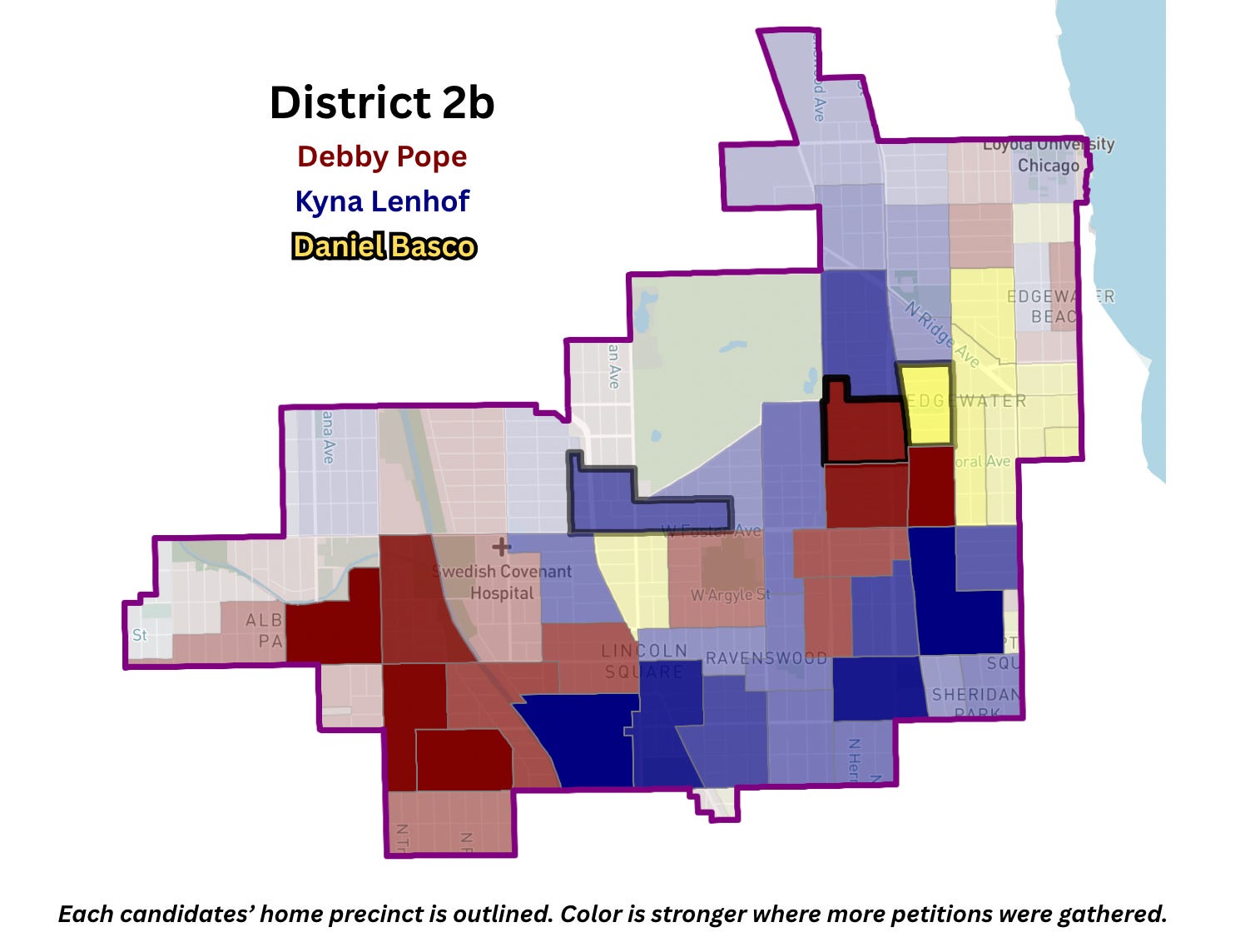
Already patterns make themselves clear. Each candidate gets a boost in their home precinct — you’re always more likely to know your neighbors, and these doors are the easiest to knock after a long day. The same is true in your broader neighborhood: we see Basco’s strength in Edgewater, Pope’s strength in Andersonville, and Lynhof’s strength in Bowmanville. The more interesting results come as we move further from a candidate’s backyard. Lenhof’s strength in the southeastern part of the district, and Pope’s strength in the southwest: these areas of strength fall along ward lines.
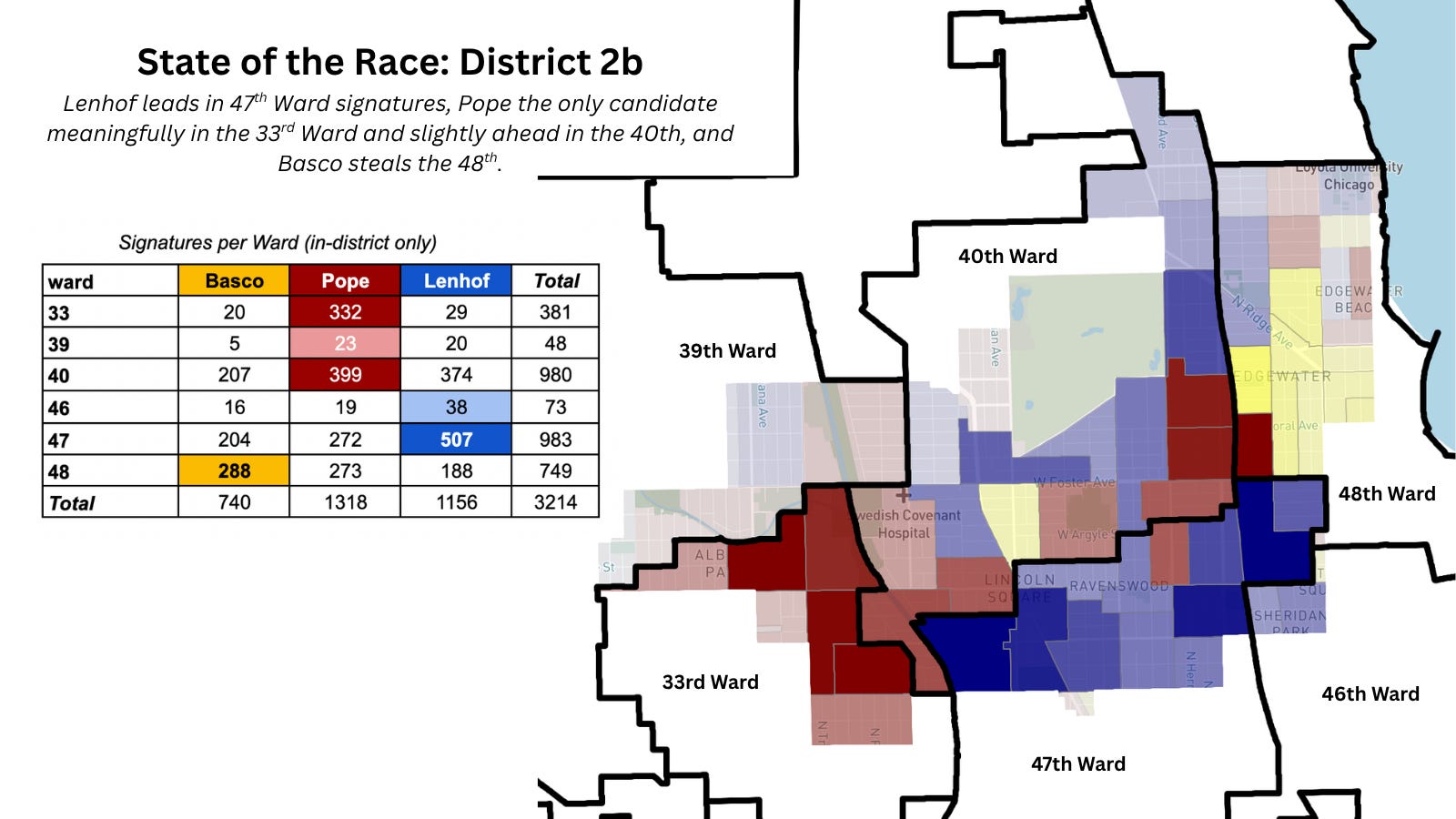
Of the four wards that make up the lions’ share of District 2b, Pope leads the number of signatures submitted in two (33rd and 40th), with Lenhof (47th) and Basco (48th) splitting the other two. The 40th Ward, home to both Pope and Lenhof and where Lenhof serves as Treasurer of the Democratic Ward Committee, is quite close, with a difference of 25 signatures of almost a thousand. The 48th Ward — a harder ward to canvass given its preponderance of apartment buildings compared to the 40th and 48th — also gives us a surprise, as newcomer Basco comes away with the most signatures. 39% of signatures submitted by the Basco campaign were in the 48th Ward; this ward-candidate combination is only topped by 43% of Lenhof’s signatures coming from the 47th Ward.
I must also note Pope’s absolute dominance in the 33rd Ward, no doubt buoyed by extensive canvassing efforts by the 33rd Ward Working Families IPO:
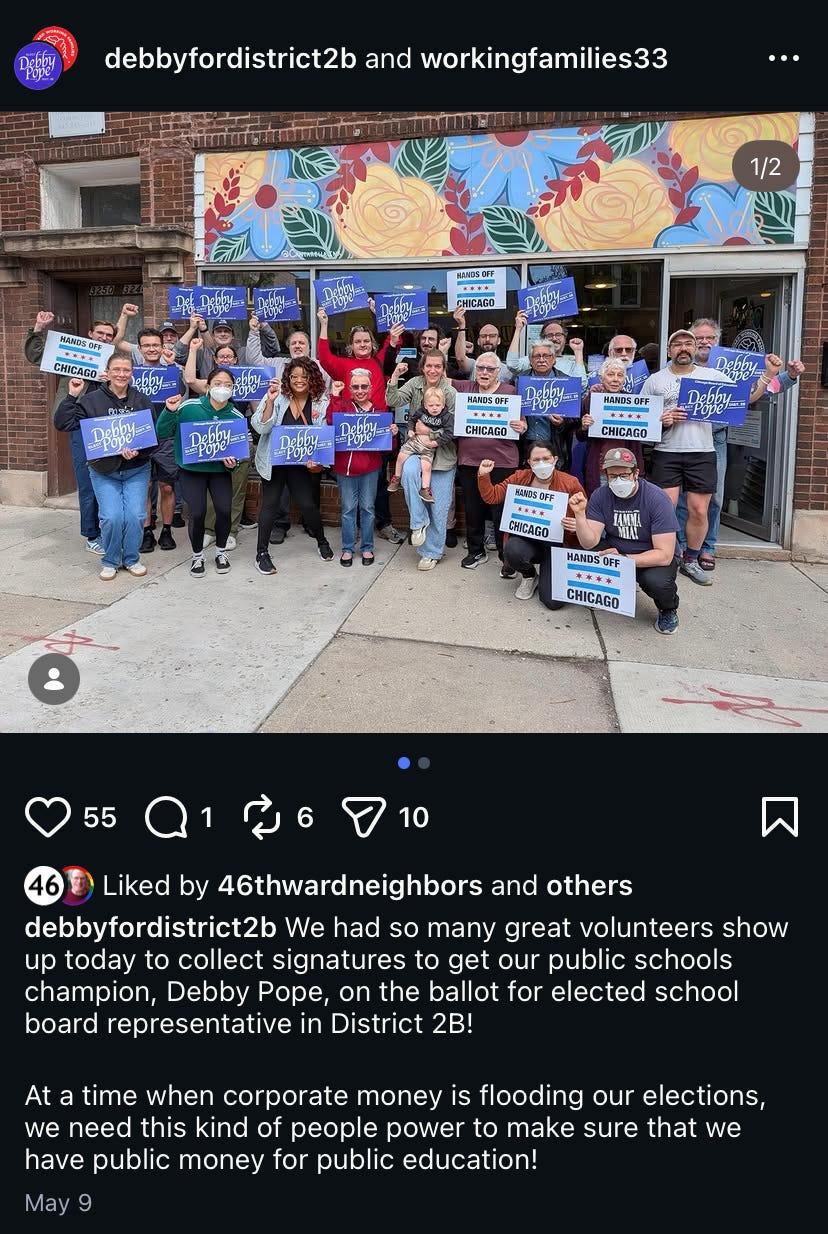
Of just seven precincts, the Pope campaign collected 332 signatures to her opponents’ combined 49. That’s a quarter of Pope’s signatures from a ward that only contributed ~11% of the district vote in 2024.
Where do we go from here?
Who’s to say? This race is still in its very early days, and both Pope and Basco face challenges to their petitions. I’ll be monitoring this race closely (as a constituent!) and I’ve already had the chance to attend Member Pope’s joint election kickoff with District 2a member Ebony DeBerry (in the critical 48th Ward, no less); I hope to attend Lenhof’s and Basco’s if I haven’t missed them.
The first major quarterly fundraising reporting deadline in this race is at the end of the month, after which we’ll have a much better sense of the races’ fault lines. As of writing, Pope has $430 in the bank, Lenhof $0 and Basco $6,500 of self-funding; donations of <$1,000 will not be public until the 15th of July.
But one thing is for certain: this’ll be a race to watch.
Bonus
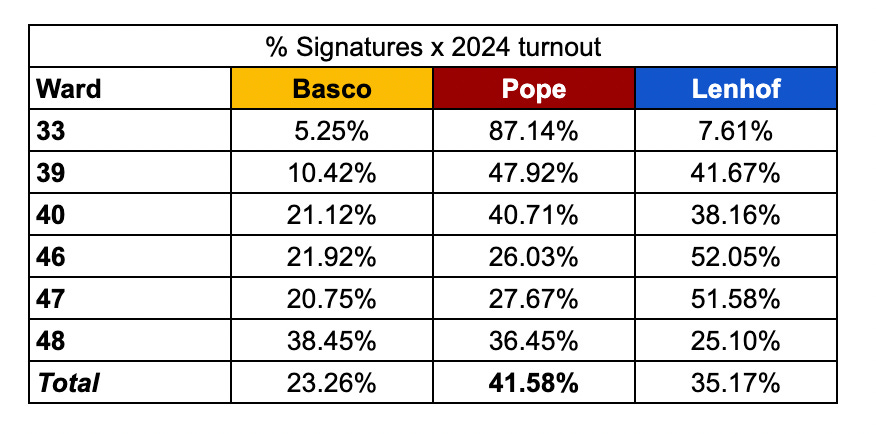
I do not believe this has any methodological value (yet!) but I would be remiss not to include the following table, an attempt to adjust # of signatures by ward turnout in 2024. This is basically in line with the raw # of signatures I managed to scrape — and remember, you can always sign for multiple candidates!